How Large Language Models (LLMs) Are Changing Dental Marketing Forever
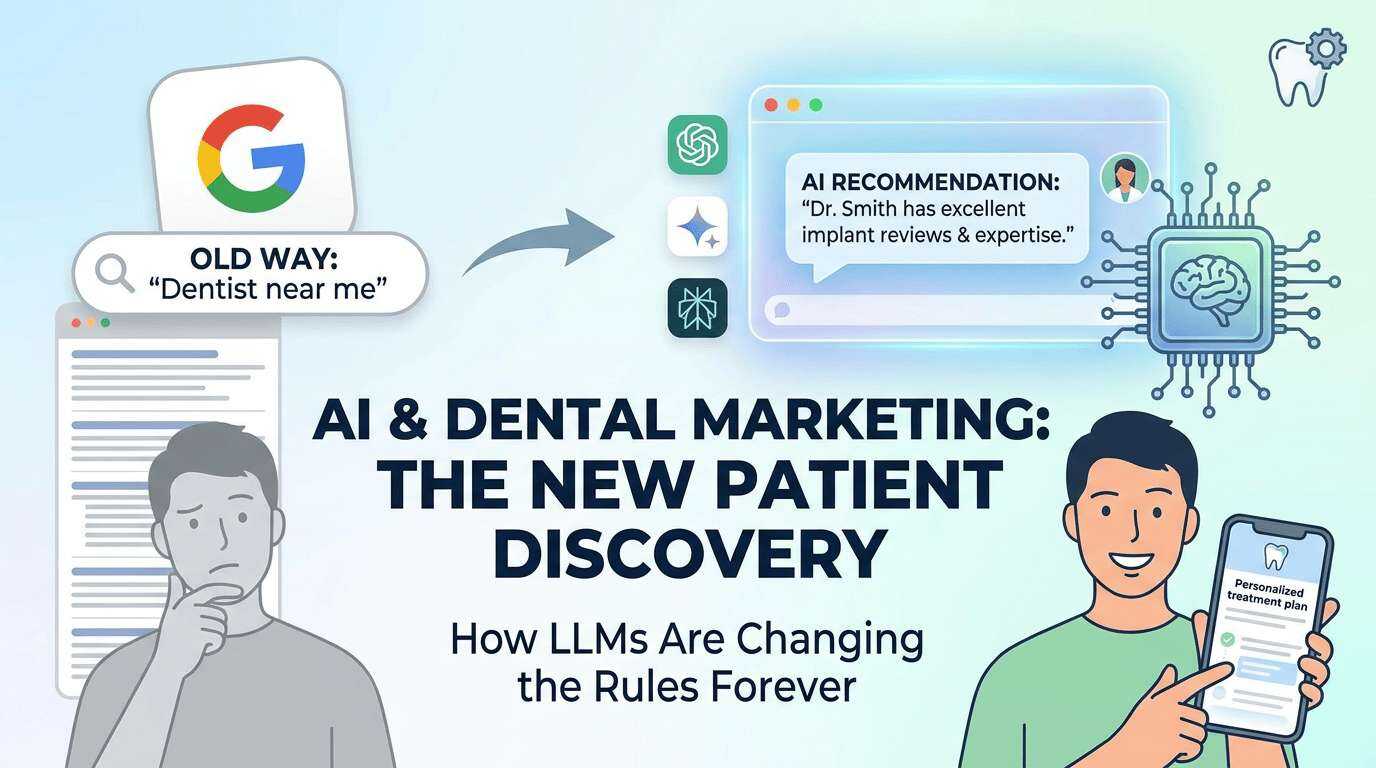
For nearly twenty years, dental marketing followed a fairly predictable formula: build a website, optimize for Google, collect reviews, run ads, rank in local search, generate leads. That strategy still works. But something significant changed over the last two years.
Patients are no longer relying exclusively on Google search results to make healthcare decisions. Today, people are asking questions directly to artificial intelligence systems — ChatGPT, Gemini, Perplexity, Claude, Google's AI Overviews and AI Mode. And increasingly, they trust the answers.
The dentists who understand this shift now will have a substantial competitive advantage over those who continue marketing as if it were still 2018.
What Is a Large Language Model (LLM)?
A Large Language Model, commonly called an LLM, is an artificial intelligence system trained on massive amounts of information that can understand questions and generate human-like responses. Examples include ChatGPT, Gemini, Claude, Perplexity, and Microsoft's Copilot.
Unlike traditional search engines that primarily return links, LLMs provide direct answers. Instead of showing ten websites and asking patients to do the research themselves, these systems summarize information, explain procedures, compare treatment options, and often recommend providers. For dentists, this represents one of the biggest shifts in patient acquisition since Google became dominant.
Why Are Patients Using AI Instead of Traditional Search?
Because it is easier. Consider a patient interested in dental implants. Five years ago they might have searched "dental implants near me," "cost of dental implants," "best implant dentist," and "implant recovery timeline" — then visited multiple websites and pieced together the answers themselves.
Today, that same patient may ask: "Who is the best dental implant provider in my area and what should I expect during treatment?" The AI can provide treatment explanations, recovery information, cost expectations, local provider suggestions, and follow-up recommendations — all within seconds. The patient saves time, the AI becomes a trusted advisor, and the practices that appear in those answers gain a tremendous advantage.
How Are LLMs Changing Local Search for Dentists?
Traditional SEO focused heavily on rankings. The goal was simple: Rank #1. The new objective is different: become the source AI systems trust. This shift changes everything.
Instead of focusing exclusively on keywords, AI systems evaluate expertise, authority, reputation, trustworthiness, brand recognition, content quality, reviews, citations, and mentions across the web. The strongest dental brands are becoming the most visible brands.
How Do ChatGPT, Gemini, and Perplexity Decide Which Dentists to Mention?
While every platform uses different systems, they generally look for the same types of signals.
Strong Website Content
AI systems need information to understand your practice. Websites with comprehensive service pages, FAQs, educational articles, and doctor biographies have significantly more authority than websites with only a few pages.
Reviews and Reputation
Reviews remain one of the strongest trust indicators available. A practice with hundreds of detailed reviews demonstrates patient satisfaction, real-world experience, and community trust. AI systems recognize these signals.
Consistent Business Information
Accurate information matters. Your name, address, phone number, services, and office hours should be consistent everywhere online. Conflicting information reduces trust.
Brand Mentions
When multiple sources mention a dental practice, authority increases. Examples include local news articles, professional associations, podcasts, interviews, community sponsorships, and industry publications. These mentions help establish credibility.
Expert Credentials
Dentists should clearly display education, professional memberships, certifications, continuing education, awards, and community involvement. AI systems look for evidence that experts are actually experts.
How Are LLMs Changing Local Search for Dentists?
Traditional SEO focused heavily on rankings. The goal was simple: Rank #1. The new objective is different: become the source AI systems trust. This shift changes everything.
Instead of focusing exclusively on keywords, AI systems evaluate expertise, authority, reputation, trustworthiness, brand recognition, content quality, reviews, citations, and mentions across the web. The strongest dental brands are becoming the most visible brands.
How Do ChatGPT, Gemini, and Perplexity Decide Which Dentists to Mention?
While every platform uses different systems, they generally look for the same types of signals.
Strong Website Content
AI systems need information to understand your practice. Websites with comprehensive service pages, FAQs, educational articles, and doctor biographies have significantly more authority than websites with only a few pages.
Reviews and Reputation
Reviews remain one of the strongest trust indicators available. A practice with hundreds of detailed reviews demonstrates patient satisfaction, real-world experience, and community trust. AI systems recognize these signals.
Consistent Business Information
Accurate information matters. Your name, address, phone number, services, and office hours should be consistent everywhere online. Conflicting information reduces trust.
Brand Mentions
When multiple sources mention a dental practice, authority increases. Examples include local news articles, professional associations, podcasts, interviews, community sponsorships, and industry publications. These mentions help establish credibility.
Expert Credentials
Dentists should clearly display education, professional memberships, certifications, continuing education, awards, and community involvement. AI systems look for evidence that experts are actually experts.
Why Rankings Alone Are No Longer Enough
Many dental practices still evaluate success based solely on rankings. While rankings remain important, they no longer tell the whole story.
Consider two practices. Practice A ranks #1. Practice B ranks #4. However, Practice B has better reviews, more educational content, stronger doctor bios, more videos, more community involvement, and more media mentions. In many AI-driven environments, Practice B may receive greater visibility despite lower rankings. Authority increasingly matters more than position alone.
What Is GEO and Why Should Dentists Care?
GEO stands for Generative Engine Optimization. While SEO focuses on rankings, GEO focuses on citations and recommendations from AI systems — including ChatGPT citations, Gemini references, Perplexity recommendations, Google AI Overview citations, and AI Mode visibility.
The objective is no longer simply ranking pages. The objective is becoming the trusted answer. Practices investing in GEO today are positioning themselves for the future of search.
What Content Helps Dentists Earn AI Visibility?
The most successful dental practices create content that directly answers patient questions.
Procedure Pages
Create dedicated pages for dental implants, Invisalign, veneers, root canals, same-day crowns, dentures, and emergency dentistry. Each page should be comprehensive, not a short paragraph.
Comparison Articles
Patients frequently compare options. Invisalign vs Braces, Veneers vs Bonding, Implants vs Bridges, and Whitening vs Veneers are topics that perform exceptionally well with AI systems.
FAQ Content
Patients constantly ask: Does Invisalign hurt? How long do dental implants last? What is a dental emergency? How much do veneers cost? Every answer creates another opportunity for visibility.
Local Resource Pages
Local content helps establish geographic authority. Examples include Emergency Dentist in Temecula, Invisalign for Teens in Murrieta, and Dental Implants in Lake Elsinore. Local relevance remains critical.
Why Video Is Becoming a Major Ranking Factor for AI
Video is one of the largest missed opportunities in dentistry. Most dentists explain procedures every day. Very few record those explanations. A simple video, just five minutes long, can answer implant questions, Invisalign questions, cosmetic dentistry questions, and emergency dental
concerns.
Video creates authority. Video builds trust. Video is highly visible within Google's ecosystem. Dentists who consistently publish video are building assets their competitors often ignore.
What Happens to Dental Websites in an AI-Driven World?
Many practice owners worry that AI will eliminate websites. The opposite is more likely. AI systems need trusted sources, and websites remain foundational. However, the role of the website is evolving.
The best dental websites now function as educational resources, authority hubs, knowledge centers, and platforms that build trust. Thin brochure websites are becoming less effective. Comprehensive authority websites are becoming more valuable.
How Can Dentists Prepare for the Future of AI Search?
The practices that win over the next decade will focus on six core areas.
1. Build a Better Website
Not just prettier. More useful, more authoritative, more comprehensive. A resource patients and AI systems can rely on.
2. Publish Consistently
Regular content signals expertise and relevance. One article per month is no longer enough.
3. Collect High-Quality Reviews
Detailed reviews help both patients and AI systems understand what makes your practice unique.
4. Invest in Video
Video creates authority at scale and is one of the fastest ways to build trust with both patients and AI systems.
5. Strengthen Your Brand
Strong brands are easier for AI systems to recognize and trust. Digital PR and community involvement matter.
6. Implement GEO Alongside SEO
Future visibility requires both. Practices optimizing only for traditional rankings are leaving AI visibility on the table.
What Are the Biggest Mistakes Dentists Are Making Right Now?
Ignoring AI Search. Many dentists still assume rankings are the only thing that matters.
Publishing Minimal Content. AI systems cannot recommend information that does not exist.
Weak Doctor Profiles. Credentials matter. Experience matters. Expertise matters. A sparse bio page signals nothing.
No Video Strategy. Patients trust faces more than webpages. Competitors publishing video are building authority you aren't.
Treating Their Website Like a Brochure. Modern dental websites should function as educational platforms, not digital business cards.
Why Digital Media Cube Is Focused on AI Visibility
At Digital Media Cube, we've spent more than twenty years helping businesses adapt to major changes in digital marketing. We've watched Yahoo decline, Google dominate, mobile transform search, and social media reshape advertising. Now we are watching AI change discovery itself.
Led by Navy veteran Adrienne DeVita, our team has generated more than $70 million in client revenue through ethical, aboveboard marketing strategies. Unlike agencies that sell multiple competitors in the same market, we work with only one client per niche per geographic area.
Our dental growth systems combine:
- SEO services
- Google Business Profile optimization
- Generative Engine Optimization (GEO)
- Google Ads management
- AI visibility strategies
- Video marketing
- Content marketing
- Branding
- Reputation management
- Custom WordPress websites
We don't chase loopholes. We build authority. And authority is becoming the most valuable asset in search driven by AI.
Frequently Asked Questions
Ready to Future-Proof Your Dental Marketing?
The next generation of patients is already asking ChatGPT, Gemini, Perplexity, and Google's AI systems for advice. The question is simple: will your dental practice be part of the answer?
If you're ready to build a dental brand that both patients and AI systems trust, request a consultation with Digital Media Cube today or call (858) 215-2572.
Ask about our Year-One Offer: Receive a FREE custom $10,780 WordPress website and first-year hosting when you enroll in our $5,000/month growth package.