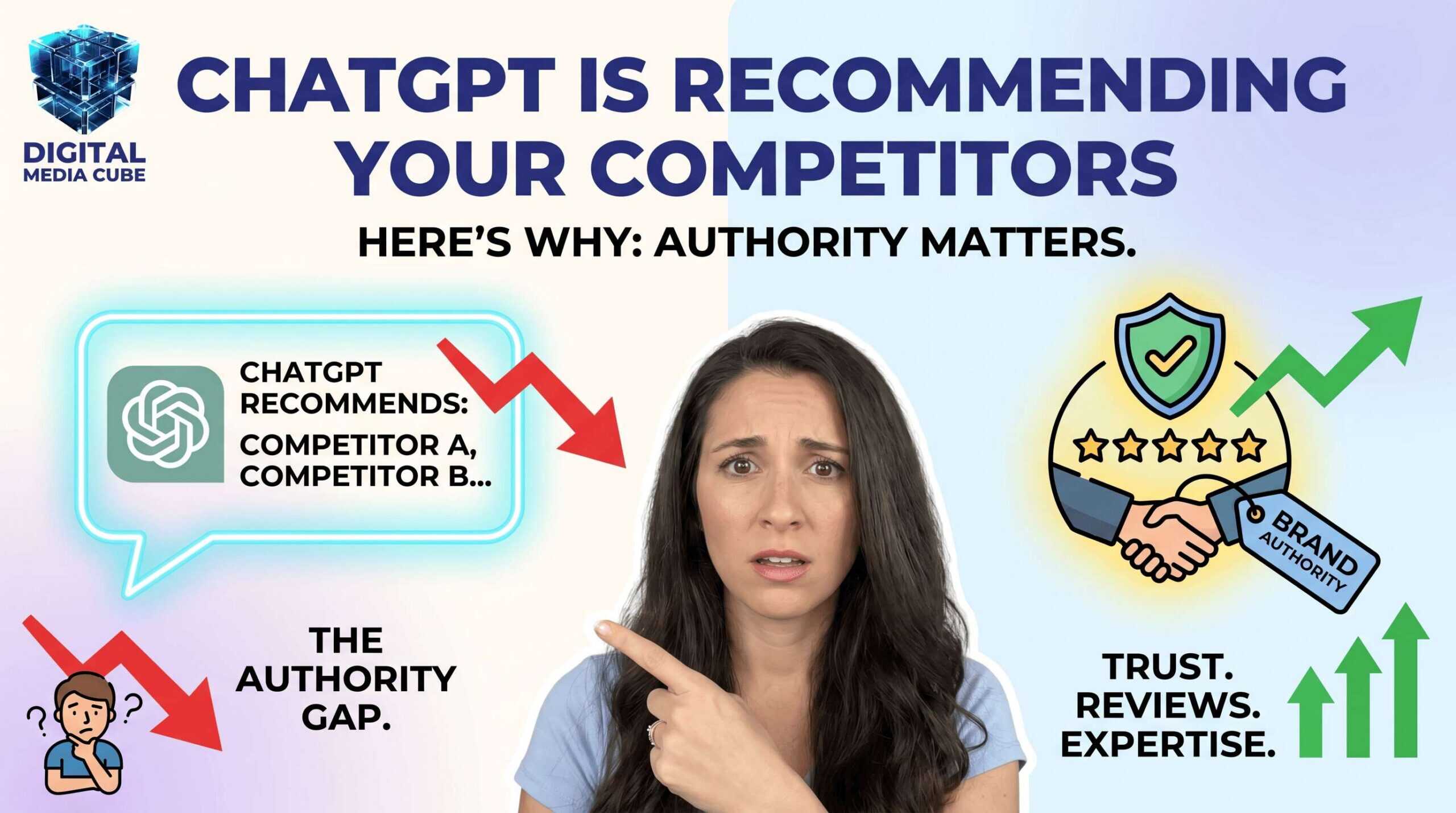
ChatGPT Is Recommending Your Competitors. Here’s Why.
The Question Nobody Asked Five Years Ago
A few years ago, nobody called a marketing agency to ask, "Is ChatGPT recommending my competitors?" The question simply didn't exist. Business owners asked why their rankings dropped, why they weren't showing up in Google Maps, why a competitor was outranking them, or why their Google Ads kept getting more expensive.
Today the conversation is different. At Digital Media Cube, we're hearing a new kind of concern, because consumers are researching differently. Patients are researching differently. Prospective students are researching differently. People aren't only searching Google anymore. They're asking AI. And that changes everything about how a business gets discovered.
I've Seen Search Change Before
One advantage of more than twenty years in this industry is perspective. I'm Adrienne DeVita, CEO of Digital Media Cube, and I've been helping businesses navigate online marketing since 2004. In that time I've watched Google reinvent itself again and again: Florida, Panda, Penguin, Hummingbird, Pigeon, RankBrain, mobile-first indexing, the Helpful Content updates, and now AI Overviews and AI Mode.
Every major shift created winners and losers, and every one created its share of fear. What makes the AI transition different is that it doesn't just rearrange rankings. It changes discovery itself: how people find a provider in the first place. That's a far bigger shift than anything we saw in the last two decades, and it rewards a very different kind of preparation.
Consumers Are No Longer Starting With Google
This is one of the biggest misconceptions I run into. Many owners still assume Google is the starting point for every customer journey. That's becoming less true by the month.
Picture a prospective dental patient. Instead of typing "Invisalign dentist near me," they may ask ChatGPT, "What should I look for when choosing an Invisalign provider?" A prospective facelift patient might ask, "Who are the most trusted facelift surgeons in my area?" A future CDL student might ask, "Which truck driving schools have the best reputation and offer one on one training?"
Notice what those have in common. They aren't keyword searches. They're conversations. And conversational search produces a different kind of winner than the old ten-blue-links results page ever did.
Why AI Search Is Different From Traditional Search
Traditional search revolved around rankings. The objective was simple: rank higher, earn the click, generate the lead. AI search works differently. Instead of handing you a list of links, these systems try to answer the question directly, and to do that they evaluate trust, authority, reputation, expertise, content quality, brand recognition, and public sentiment.
So the question driving visibility has quietly changed. Traditional search asked, "Who ranks highest?" AI search increasingly asks, "Who deserves to be recommended?" That's a completely different framework, and it's why some businesses with modest rankings are suddenly showing up inside AI answers while competitors that rank higher get left out.
The One Thing Recommended Businesses Have in Common
Authority. Not traffic, not rankings: authority.
This is where a lot of owners get frustrated. They've spent years chasing rankings, and now they're watching competitors surface inside AI-generated answers instead. How does that happen? Because authority compounds.
Think about how people choose a provider in the real world. Would you rather visit a business you've never heard of, or one with strong reviews, a solid reputation, visible community involvement, real credentials, helpful content, and positive mentions across the web? Most people choose the second. AI systems increasingly make the same kind of evaluation. They're looking for the signals a careful human would look for.
What ChatGPT Actually Looks For
Many people imagine ChatGPT simply scanning websites for keywords. That isn't how modern AI works. These systems try to assemble a picture of your business from signals scattered across many sources, and a handful of those signals matter most.
Reviews establish trust from the real world. Demonstrated expertise and professional credentials establish authority. Helpful content tells the AI what you actually do and who you serve. Consistent, accurate business information across the web reassures it that you're a real, established entity. And brand mentions strengthen your credibility further: references to your practice on news sites, podcasts, directories, social platforms, and community pages. In other words, AI systems are largely looking for the same things consumers use to make a decision.
Why Reviews Are Becoming the New Rankings
If there's one trend I'd urge every owner to take seriously right now, it's this: reviews are becoming far more important than most people realize. For years they mostly influenced Google Maps visibility, local SEO, and consumer trust. Today they influence something bigger: authority.
Look at it from the AI's perspective. If ChatGPT, Gemini, Perplexity, or Google's AI systems are trying to decide which businesses deserve visibility, what's more persuasive: a business claiming it's great, or hundreds of customers describing exactly why it is? Reviews provide validation from the real world. They tell stories, describe outcomes, and help AI understand what a business is actually known for.
That last point is the key. A review that says "Great dentist" is pleasant but thin. A review that says "Dr. Smith finished my Invisalign treatment in 14 months and the results exceeded my expectations" is far more valuable, because it communicates a specific outcome and a specific expertise. The more specific the review, the stronger the signal, and that holds whether you're a dentist, an orthodontist, a plastic surgeon, or a truck driving school.
We see it with our own clients. One of our truck driving school clients saw enrollment grow by more than 57% within seven months, with noticeably stronger visibility across both traditional search and the newer AI-powered search tools. That kind of outcome tells a story both prospective students and AI systems can recognize.
What Is Entity SEO, and Why Should You Care?
Most owners have never heard the phrase "entity SEO," but they're about to. Historically, search engines focused on keywords. Today they increasingly focus on entities, and on the relationships between them.
An entity is a recognized person, business, or place with a defined identity. Adrienne DeVita is an entity. Digital Media Cube is an entity. A cosmetic dentist, an orthodontic practice, a plastic surgery group, and a truck driving school are all entities. What search engines and AI systems are really trying to work out is who you are, what you do, where you operate, what you're known for, and why consumers trust you. The businesses that communicate those signals clearly, consistently, across the whole web, gain an advantage that rankings alone can't explain.
Why Branding Has Become an SEO Strategy
For years, many owners treated branding and SEO as separate activities. That line is disappearing. Strong brands generate more searches, more reviews, more referrals, more mentions, and more trust, and every one of those feeds authority. Weak brands depend almost entirely on rankings. Strong brands become destinations.
When someone searches for your practice by name, that's a powerful signal. When people mention your company online without being prompted, that's a powerful signal. And people can't mention a brand they don't remember, which is exactly why brand building has quietly become one of the most overlooked competitive advantages in digital marketing. AI is only reinforcing that.
Why Dentists and Orthodontists Need to Pay Attention
Dentistry may be one of the industries most affected by AI search, and orthodontics is right alongside it. Think about how many questions patients ask before they ever book: how much Invisalign costs, whether veneers are worth it, whether a root canal hurts, how long implants last, what causes gum disease. Those searches used to drive website visits. Now AI often answers them on the spot.
The practices still winning are the ones becoming trusted educational resources: building real doctor biographies, hundreds of detailed reviews, procedure guides, comparison articles, and video. They're establishing authority before a patient ever picks up the phone. As one of our Lake Elsinore dental clients put it:
Here's the part that surprises owners most. Imagine two orthodontists: Orthodontist A ranks first, Orthodontist B ranks fourth. Traditional thinking says A dominates. But if B has better reviews, better video, better patient education, more community involvement, and stronger brand recognition, AI systems may well favor B. Rankings still matter. They're just becoming a smaller piece of the puzzle than they used to be.
The Opportunity for Plastic Surgeons
Plastic surgery is one of the most reputation-driven industries in the world. Patients rarely act on impulse; they research for weeks or months, comparing procedures, costs, risks, recovery timelines, and providers, and scrutinizing credentials and reviews before they ever schedule a consultation.
AI mirrors and accelerates that process. A prospective patient can ask, "What's the difference between a mini facelift and a deep plane facelift?", then immediately follow with "How do I choose the best facelift surgeon?" and "Who has the strongest reputation in my area?" The surgeon who has built genuine authority becomes part of those answers. The surgeon who hasn't may never enter the conversation at all. That doesn't happen by accident. It's the result of years of deliberately building trust.
What Medical Practices Often Get Wrong
Many medical practices still treat their website like a digital brochure: a list of services, the office hours, a contact form, and not much else. The problem is that both patients and AI systems need information, and a brochure doesn't build authority. Education does.
A strong medical site answers the questions patients are actually asking — what to expect, what treatment options exist, what the risks and benefits are, and how recovery works. Every honest answer is another chance to demonstrate expertise, and every demonstration of expertise is another signal that you're worth recommending.
Why Truck Driving Schools Have a Real Opening
Most truck driving schools haven't caught up to AI search yet, and that's precisely where the opportunity lies. Today's students are asking how to get a CDL, which endorsements pay the most, which school to choose, whether individual training is better, and how long training takes. AI is increasingly answering those questions, and the schools that have become the trusted answer are pulling ahead.
This is a space we genuinely like working in, especially with schools built around online theory students can complete from home paired with practical instruction given one on one. Those differentiators are a content goldmine: they give you real, specific things to explain, compare, and demonstrate, which is exactly what builds authority. When mostcompetitors are doing very little, a school that consistently publishes CDL guides, endorsement breakdowns, career advice, and honest training comparisons can establish authority relatively quickly, and become the school AI points students toward.
AI Citations Are Becoming the New Backlinks
Backlinks still matter, and they probably always will. But something new is emerging alongside them: AI citations. When an AI system references your content, names your business, or surfaces your information in an answer, it's effectively validating your authority in front of a potential customer.
This is why Generative Engine Optimization (GEO) has become so important. GEO is the work of making your business visible inside ChatGPT, Gemini, Perplexity, Claude, Google AI Overviews, and Google AI Mode. The goal is no longer simply to rank. The goal is to become part of the answer.
Why Shortcuts Still Fail
I've been doing this long enough to have seen every shortcut imaginable: keyword stuffing, link schemes, private blog networks, fake reviews, spun content. Every few years someone announces an easier path, and every few years Google catches up. The businesses that survive are the ones that built real authority; the ones chasing loopholes tend to disappear.
AI search is accelerating that reality, because trust is becoming genuinely hard to fake. You can't manufacture years of detailed reviews, real credentials, and consistent brand mentions overnight. That's not a limitation. It's the whole point, and it's why honest, ethical work compounds in your favor over time.
The DMC Authority Framework
Over the years I've become convinced that businesses win online when they consistently strengthen five core areas:
Visibility: can people find you?
Authority: do people trustyour expertise?
Reputation: what do customers actually say about you?
Brand: do people remember you?
And Conversion: when people find you, do they take action?
Most businesses focus on only one or two of these, usually visibility and rankings, and then wonder why growth stalls. The strongest businesses work on all five at once, andthat balance has only become more important as AI search reshapes how discovery happens.
How to Improve Your Odds of Being Recommended
There are no guarantees, but the businesses that consistently improve a few areas tend to perform better. Create genuinely helpful content that answers real questions. Encourage detailed, specific reviews rather than bare star ratings. Strengthen your brand so people remember you and search for you by name. Keep your business information accurate everywhere to reinforce your local SEO. Produce video that shows your expertise. And expand your digital footprint so you earn mentions well beyond your own website. None of these are shortcuts, which is exactly why they work.
What to Measure Going Forward
Plenty of businesses are still fixated on rankings or raw traffic. Those numbers matter, but they shouldn't be the main scoreboard anymore. I'd encourage owners to watch qualified leads, consultation and appointment requests, phone calls, revenue growth, review growth, branded searches, referral traffic, and AI visibility. Those metrics line up far more closely with the actual health of a practice or a school than a ranking report ever did.
Frequently Asked Questions
The Businesses That Win Will Be the Ones AI Trusts
For years, businesses competed mainly for rankings. Today they're competing for recommendations, and that distinction matters more than it sounds. Consumers are asking AI systems who they should trust, who has the best reputation, who the real expert is, and who they should call. The businesses that have steadily built authority are positioning themselves to become those answers.
At Digital Media Cube, that's exactly what we help clients do: not simply rank, and not simply generate traffic, but build authority, build trust, and build brands. Because in the age of AI search, the businesses that are remembered and recommended will hold a real advantage over the ones that are merely foun