Your Website Traffic Is Falling. Google Says That’s the Future.
that AI systems recognize and recommend.
Something Strange Is Happening
For more than twenty years, business owners have measured success online using a handful of familiar numbers: website traffic, keyword rankings, clicks, impressions, and leads. For a long time, those numbers moved together. If rankings improved, traffic improved. If traffic improved, leads improved. If leads improved, revenue improved. It was simple, predictable, and easy to explain to a practice owner who just wanted a fuller schedule.
Over the past two years, that relationship has broken down. Business owners are calling their marketing agencies asking questions like:
- "Why are my rankings up but my traffic is down?"
- "Why am I showing up on page one but getting fewer clicks?"
- "Why does Google look completely different than it used to?"
- "Why is ChatGPT talking about my competitors and not me?"
Those are legitimate questions. And after more than twenty years in search marketing, I can tell you that what we're seeing today is one of the most significant shifts since Google became the dominant search engine in the first place.
I've Seen This Movie Before
I'm Adrienne DeVita, CEO of Digital Media Cube, and I've been working in search marketing since 2004. Over those years I've watched business owners panic through nearly every major Google update imaginable: Florida, Panda, Penguin, the explosion of mobile search, the rise of local search, and the moment social media went from optional to unavoidable. Now I'm watching it happen again with AI.
Every major shift follows the same pattern. It creates confusion, it creates winners, and it creates losers. The practices that adapt early usually thrive. The ones that assume nothing has changed usually spend the next few years trying to catch up. This time is no different. The only thing that's new is the technology driving the change.
Why Website Traffic Is Falling Even When Rankings Stay the Same
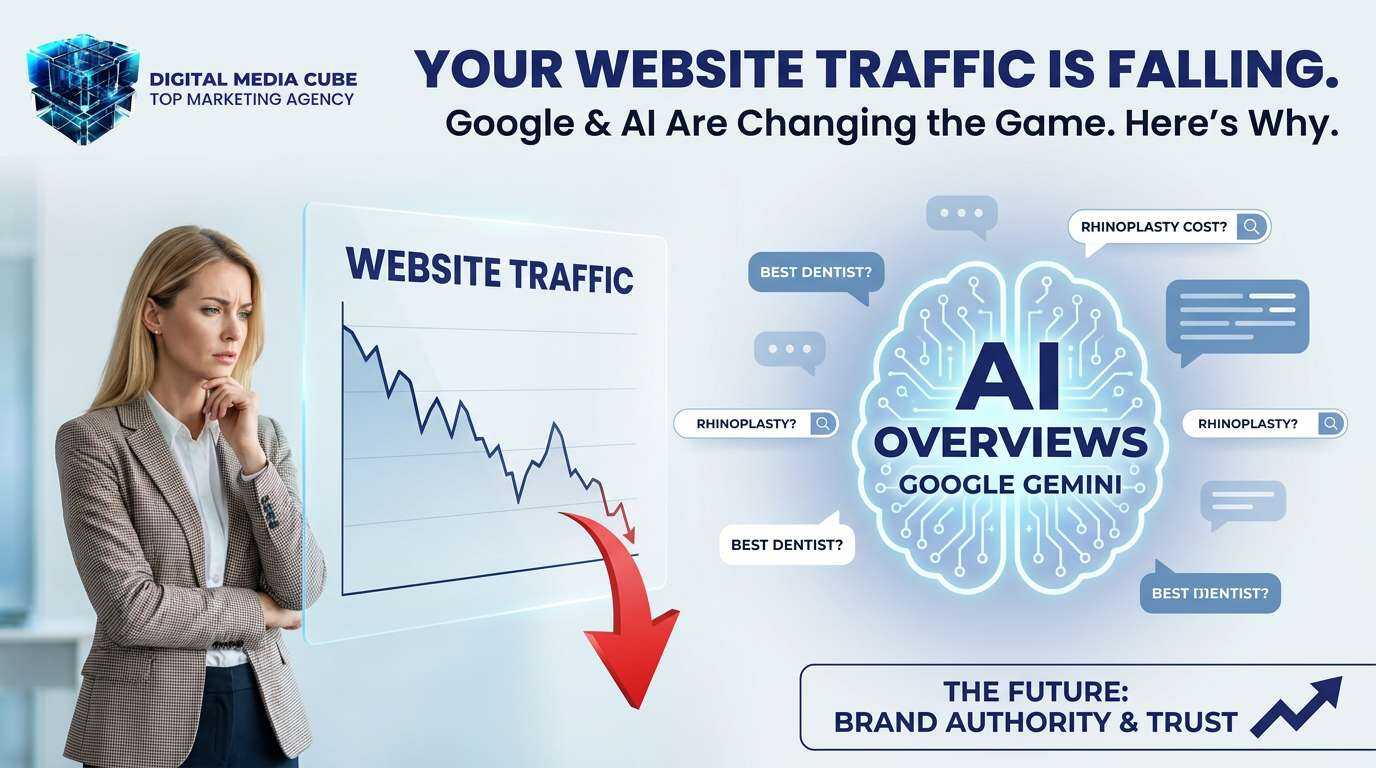
This is the part many practice owners find genuinely frustrating. You can still rank well, you can still have good SEO, you can still be visible, and your traffic can decline anyway. The reason is that Google increasingly answers the question before the user ever clicks.
Think about how people search today. A prospective dental patient might ask how long dental implants last, whether Invisalign hurts, or what veneers actually cost. A prospective plastic surgery patient might ask about facelift recovery time, the price of rhinoplasty, or whether breast implants are safe. A few years ago, every one of those questions sent someone to a website. Today, many of them are answered directly inside Google AI Overviews, Google AI Mode, ChatGPT, Gemini, or Perplexity.
The click never happens. The user gets the answer, Google keeps the visitor, and the practice loses the traffic. This is what's known as a zero-click search, and it is becoming more common every quarter.
Google Is Not Trying to Send You More Traffic
This is one of the hardest truths for business owners to accept. Google's primary responsibility is not to your practice. It's to Google's users. If those users get faster, better answers through responses generated by AI, Google considers that a win, even if it means a website never gets the visit.
That means many searches that once produced website traffic now begin and end inside Google's own ecosystem. This isn't a temporary experiment or a passing test. It's the direction search is moving, and the sooner a practice accepts that reality, the faster it can adapt to it.
Why This Matters So Much for Dentists
Dentists may be among the most affected of all. Prospective patients tend to do a lot of homework before they pick up the phone, asking things like how much Invisalign costs, whether dental implants are painful, how long veneers last, what causes gum disease, and whether a root canal really hurts.
Historically, those questions generated traffic to dental websites. Now Google and AI systems frequently answer them outright. The practices that still attract new patients are the ones that have become trusted sources, the ones building authority rather than relying on rankings alone. As one of our dental clients put it:
"I have spent many years and lots of wasted money trying to market my dental office in the online market. After speaking with Adrienne DeVita, I soon realized how ineffective my current online marketing strategy was. I was paying a company a lot of money for absolutely nothing in return.
Adrienne has unbelievable knowledge and understanding of the SEO market. In a very short period of time, my business gained solid rankings on Google, Bing, and Yahoo and she has been able to maintain them. She was able to increase our revenue from online sources in only a few weeks, and I made my money back in just 6 weeks. I continue to hire her for unique content and optimization, as well as my social directory listings to bring my rankings up for many keywords in the #1 position.
She is a very dedicated and passionate person and will go the extra mile to make sure she has created the best possible opportunities for your business. I strongly recommend Adrienne and her vast expertise with Search Engine Marketing to build your online marketing strategy from the ground up."
Derek B. Hauser, DDS
That comment reflects what we're seeing across healthcare. Visibility by itself is no longer enough. The right visibility, being the name that earns trust, is what matters.
Plastic Surgeons Face an Even Bigger Challenge
Plastic surgery is one of the most heavily researched categories online. Patients often spend weeks or months comparing providers before they ever schedule a consultation, digging into facelifts, rhinoplasty, breast augmentation, eyelid surgery, recovery timelines, risks, and costs.
AI search compresses that research dramatically. A patient can now ask, "Who is the best plastic surgeon for a facelift near me?" and get a detailed, comparative answer in seconds. That means plastic surgeons are no longer competing only for rankings. They're competing for trust, for authority, and for the recommendation itself. It's a very different game, and it rewards a very different kind of preparation.
Why Rankings Alone No Longer Tell the Whole Story
For years, agencies sold rankings, and some still do. The problem is that rankings have become an incomplete metric. Imagine two practices: Practice A ranks first, and Practice B ranks fourth. Traditional thinking says Practice A wins.
But what if Practice B has better reviews, more helpful content, stronger branding, better video, more authority, a better local reputation, and more mentions across the web? Increasingly, AI systems may favor Practice B, because authority, trust, and recognition now carry real weight. This is where a lot of businesses get stuck: they're still measuring yesterday's scoreboard while the rules of the game are quietly being rewritten.
The Rise of Brand Authority
At Digital Media Cube, we've always believed branding and SEO are connected. Today that connection is stronger than it has ever been. Strong brands generate more searches, more reviews, more referrals, more mentions, and more trust. When consumers recognize a brand, search engines notice. And when AI systems repeatedly encounter a brand across the web, they notice too.
That's why we spend real time helping clients build a brand rather than simply chasing rankings. Rankings can disappear with a single algorithm update. Brands endure through them.
What Is Entity SEO, and Why Does It Matter?
One of the most important concepts in modern search is entity SEO. Google no longer views your practice as a collection of keywords. Instead, it tries to understand your practice as an entity, a recognized person, organization, or place with a defined identity and reputation.
It helps to see how this works in practice. Adrienne DeVita is an entity. Digital Media Cube is an entity. Your dental practice is an entity, and so is your name as the surgeon or dentist behind it. Google's job is to understand who you are, what you do, where you operate, and why consumers
trust you, and then to connect those entities to one another in ways that build a coherent picture of your authority.
That picture is assembled from signals: consistent business information, reviews, media mentions, video, professional credentials, community involvement, and references from other trusted sources. Every one of those signals tells Google and the AI platforms that you are a real, credible entity worth recommending. The practices that communicate those signals clearly often gain advantages that rankings alone can't explain.
Why Reviews Have Become More Powerful Than Ever
Reviews are no longer just a local SEO signal. They've become a trust signal, and trust is one of the most valuable assets in AI search. Detailed, specific reviews help both consumers and AI systems understand what actually makes a practice different.
Content Is Not Dead. Bad Content Is.
Every time search changes, someone announces that content marketing is dead. I've heard it for years. They were wrong then, and they're wrong now. AI systems still need sources to draw from. They don't invent trust out of nothing. What's changed is that weak content is becoming worthless
while genuinely helpful content is becoming more valuable than ever.
The goal is to create content that truly answers the questions your patients are asking. For dentists, that might mean clear dental implant FAQs, honest Invisalign comparisons, practical veneer guides, and emergency care resources. For plastic surgeons, it might mean realistic recovery timelines, procedure comparisons set side by side, frank safety discussions, and transparent cost considerations.
The point is no longer simply to attract traffic. The point is to become the trusted resource that patients, and the AI systems they rely on, return to.
What Practices Should Measure Instead
One of the biggest mistakes I see is owners obsessing over traffic. Traffic matters, but it was never the actual goal. Revenue is the goal. Qualified leads, booked consultations, and filled appointments are the goal.
Instead of fixating on raw traffic, practices should track qualified leads, phone calls, appointment and consultation requests, revenue growth, review growth, branded searches, and AI visibility. Those metrics give a far clearer picture of whether your marketing is actually building the practice.
Why Most Agencies Are Still Talking About SEO Like It's 2018
Here's where it gets interesting. A lot of agencies are still selling the exact strategy they sold years ago: more keywords, more rankings, more traffic. Those things still matter, but on their own, they're no longer enough.
A modern practice needs SEO and local SEO, yes, but also reputation management, brand development, video marketing, thought leadership, GEO (Generative Engine Optimization), and a deliberate AI visibility search strategy. The future belongs to practices that understand the entire ecosystem rather than one slice of it.
What Smart Practices Are Doing Right Now
The practices adapting fastest are working on all of it at once. They're building a recognizable brand, generating more and better reviews, creating content that genuinely helps, producing video, strengthening their Google Business Profile, expanding their digital footprint across the web, and deliberately preparing to be cited by AI search tools. In short, they're positioning for where search is going instead of clinging to where it has been.
The Real Question Business Owners Should Be Asking
Most owners ask, "How do I get more traffic?" That may no longer be the most useful question. A better one is:
"How do I become the practice that Google, ChatGPT, Gemini, and Perplexity trust enough to recommend?"
That shift in thinking changes everything, because recommendations are becoming more valuable than rankings, authority more valuable than traffic, and trust more valuable than clicks.
Frequently Asked Questions
The Future Belongs to Trusted Brands
Search is changing. Traffic is changing. Consumer behavior is changing. What isn't changing is the importance of trust. Practices that build authority, strengthen their brand, earn meaningful reviews, create genuinely helpful content, and establish themselves as trusted resources will continue to thrive, regardless of how the technology evolves.
The practices that rely solely on rankings may soon find themselves wondering where the clicks went. Because the future of search isn't simply about being found. It's about being recommended. And the practices that understand that distinction today will be the ones leading their fields tomorrow.