The Post-GLP-1 Patient Is Already Searching. Is Your Practice the One They Find?
By Adrienne DeVita, Founder and CEO, Digital Media Cube
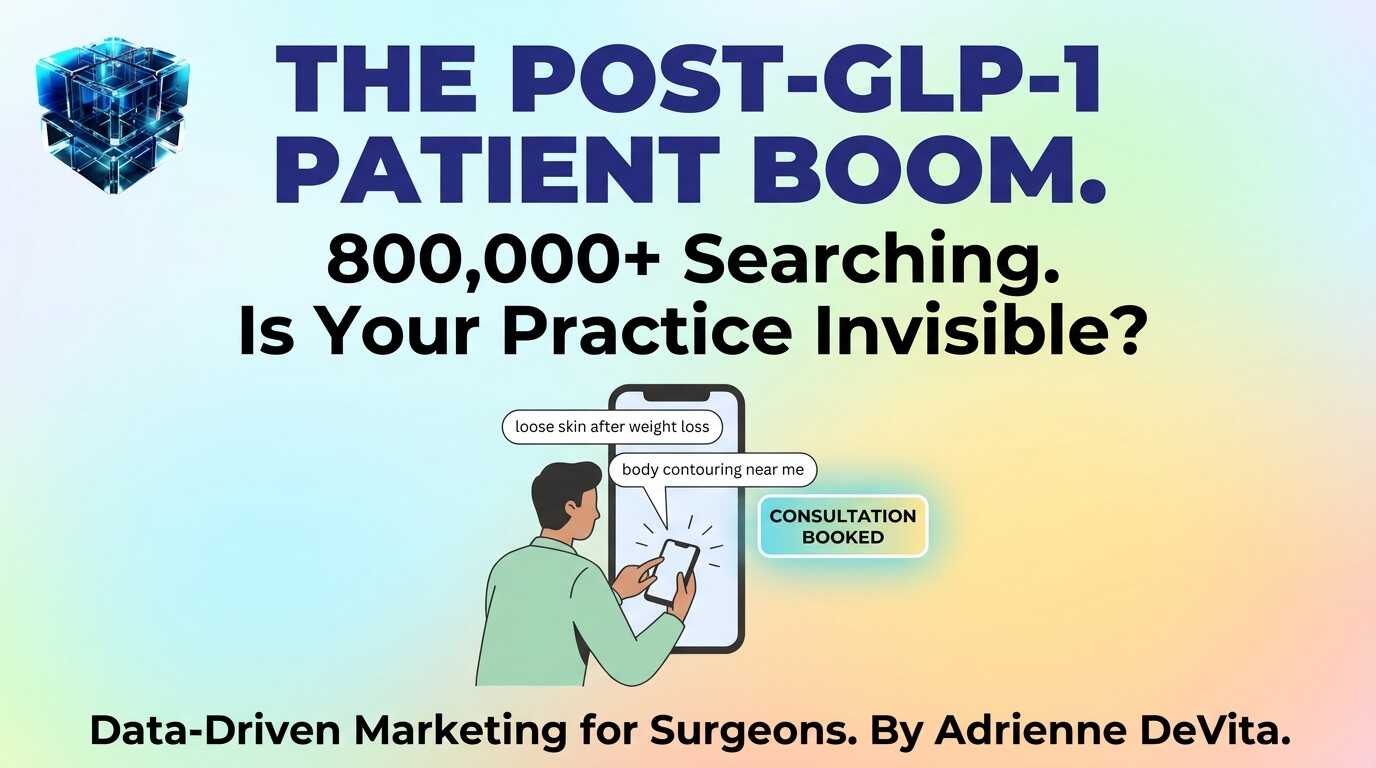
The largest new patient segment in cosmetic surgery is not being created by advertising. It is being created by prescriptions. When the American Society of Plastic Surgeons measured weight loss medication use among aesthetic patients for the first time in its 2024 Procedural Statistics Report, it counted more than 800,000 of them, and found that 39 percent were considering a surgical procedure while another 41 percent were considering something nonsurgical. That is a pipeline of people who have not booked yet. Most of them are researching right now, in language your website probably does not use.
I have been marketing high ticket medical practices since 2004, and I have not seen a demand shift like this one. Not because the procedures are new, because they are not. Body contouring after major weight loss is well established surgery. What is new is the volume, the speed, and the fact that a large share of these patients have never considered plastic surgery before in their lives.
That last part is what most practice marketing is getting wrong.
What the Data Says
Let me start with numbers from the source rather than from the marketing blogs recycling them.
The 2024 ASPS Procedural Statistics Report, released in June 2025, found that nearly 1.6 million cosmetic surgical procedures were performed that year, with surgical volume up 1 percent and minimally invasive treatments up 3 percent over 2023. (ASPS)
Inside that stable overall picture, one category moved. Body contouring saw the highest growth, with thigh and buttock lifts up 3 percent and arm and neck lifts up 2 percent. ASPS President Dr. Scott Hollenbeck connected that movement to the rising use of GLP-1 weight loss medications and the skin laxity that follows rapid loss.
Then there is the finding that matters most for planning. Among GLP-1 patients under the care of ASPS member surgeons, 20 percent had already undergone plastic surgery, 39 percent were considering a surgical procedure, and 41 percent were considering a nonsurgical one.
Sit with the 39 percent for a second. Roughly two in five of these patients had decided they wanted surgery and had not yet chosen a surgeon. In marketing terms, that is not a demand problem. That is a discovery problem, and discovery problems are solvable.
ASPS has continued to flag this as a defining theme, naming GLP-1 makeovers among the trends shaping 2026 and describing an era focused on refinement and preservation rather than dramatic transformation. (ASPS 2026 trends)
This Patient Is Not Your Usual Patient
Here is where practice marketing tends to break down. The post weight loss patient does not behave like the traditional cosmetic patient, and messaging built for one does not convert the other.
The traditional aesthetic patient has often been considering a procedure for years. They arrive with vocabulary, a surgeon shortlist, and a fairly specific ask. Your existing site speaks to them well, because it was built for them.
The post-GLP-1 patient frequently arrives with none of that. Many are first time cosmetic patients who spent their adult lives assuming plastic surgery was for other people. They did not set out to have surgery. They set out to lose weight, succeeded, and encountered a physical result nobody warned them about. Their emotional state is different too. There is often pride mixed with frustration, and a real sensitivity about being judged for wanting more after having already achieved something difficult.
They also have a distinct objection set. Is this vanity? Have I earned this? Will insurance touch any of it? How much of this is one operation and how much is three? Am I going to have scars that are worse than what I have now? Do I have to be off my medication, and for how long?
If your website answers none of those questions, it does not matter how well you rank. The patient reads it, feels unseen, and keeps looking.
The Vocabulary Gap Costing Practices Consultations
This is the single most common technical mistake I find when I audit a plastic surgery site, and it is worth more than any other fix on this list.
Surgeons write in surgical language. Patients search in plain language.
Your site says brachioplasty. She is typing "loose skin on arms after losing weight." Your site says abdominoplasty with flankplasty. He is typing "extra skin on my stomach after Ozempic." Your site says facial fat grafting for volume restoration. She is typing "why does my face look older since I lost weight."
Search engines have gotten reasonably good at bridging that gap. AI systems are better at it, because they match meaning rather than strings. But neither can put you in an answer if your site has never addressed the concern in any recognizable form. And when an AI assistant assembles a recommendation, it is drawing on pages that genuinely engage with the patient's situation, not pages that list procedure names.
The practices winning this segment have built content that meets the patient where they are: at the moment of noticing, not at the moment of knowing what to ask for.
What the Content Architecture Should Look Like
For a practice serious about this segment, here is the structure I build:
- A dedicated post weight loss hub, not a single page. One page mentioning body contouring is not enough to establish topical authority. The hub covers the journey, then branches into individual concerns.
- Concern first pages, procedure second. Build around loose skin on the arms, the abdomen, the thighs, the chest, and facial volume loss. Name the procedure inside the page once you have described the concern in the patient's own words.
- Sequencing and staging content. These patients often need multiple procedures over time, and that is the most common thing they do not understand going in. A clear, honest explanation of what gets combined and what gets staged separates a serious practice from a practice fishing for a deposit.
- Weight stability guidance. The question of when a patient is ready is the number one thing they search and the number one thing they get wrong advice about. Answering it well is a trust event.
- Cost and financing transparency. Not a single number, since these cases vary enormously, but ranges and financing structure. Practices that say nothing get skipped by both patients and AI systems assembling comparisons.
- Real before and after evidence for this specific patient type. A gallery of traditional tummy tucks does not reassure someone who lost 90 pounds. Show cases that look like their case.
- Board certification stated plainly and prominently. More on why this matters below.
- Video built from what you already have. You do not need a production crew in your office. We take clips and images a practice already has and produce polished, commercialized video from them, which is how most of our clients get video without the disruption of a shoot.
Why Board Certification Is a Marketing Asset Now
The GLP-1 wave did not just create demand for surgeons. It created demand that med spas, weight loss clinics, and non core practitioners are aggressively pursuing with nonsurgical skin tightening, devices, and injectables.
Some of that is legitimate. For mild laxity, nonsurgical options are a reasonable path, and the ASPS data itself shows 41 percent of these patients considering nonsurgical routes. But you are now competing for the same searches against businesses with lower overhead, faster marketing cycles, and fewer constraints on what they can claim.
You cannot win that fight on volume. You win it on trust signals, and this is one of the few categories where trust signals are also ranking signals.
Cosmetic surgery content sits squarely in the category search engines treat most cautiously, the kind where a wrong answer can hurt someone. Author attribution to a named, credentialed surgeon, clear credentials on every clinical page, an author bio that connects to real professional entities, and consistency between what your site says about you and what every directory and profile says about you all matter more here than in almost any other industry we serve. Off site reputation is read as source material too, which means reviews, press, and professional listings are part of the picture.
This is the core of the plastic surgery marketing work we do. Not volume content, authority content, built so both a nervous patient and an AI system come away confident about who you are.
The Timing Argument
I want to be honest about something, because I would rather be useful than persuasive.
Nobody knows exactly how long this wave lasts. Prescribing patterns change, formulations change, coverage changes. Anyone telling you they have modeled the next five years of GLP-1 aesthetic demand is guessing with confidence.
What we do know is that the patients who started medication in 2024 and 2025 are reaching weight stability now, and ASPS data says a large share of them intend to pursue surgery. The content you publish today needs three to six months to mature into meaningful visibility. Content published in response to a competitor already dominating the category takes considerably longer and costs considerably more.
The window is not closing tomorrow. It is also not open forever, and in every market I have watched, the practice that establishes topical authority first is remarkably hard to dislodge later.
What We Do, in Plain Terms
I will be direct about scope, because plastic surgery practices get pitched constantly by specialists who only do one thing.
We handle everything except email marketing. Custom WordPress websites built for both patient conversion and machine legibility. Full SEO and Google Business Profile management. Content written around the patient journey rather than keyword lists. Video production assembled from your existing footage and images. Social media. Press releases. Google Ads, which we run alongside organic work rather than instead of it, because for high ticket procedures in competitive metros you want both. And branding, which is the thread through all of it.
That last one is the part I care about most. This marketing agency has never chased rankings as the goal. Rankings are a byproduct of building a practice that people remember by name and search for directly. In a market where AI systems are increasingly deciding which three surgeons get mentioned, being a recognized brand is not a soft objective anymore. It is the mechanism.
We also work with one client per niche per geographic area. For a plastic surgeon, that guarantee is worth more than it sounds. It means we will never take on the practice across town while we are learning your market, your procedure mix, and your patient objections. That exclusivity is real, it is enforced, and it means most metros are open to exactly one practice.
Where to Start
If you take nothing else from this, take these three things.
Open your own website and search it for the phrase "weight loss." If the only results are a paragraph on a body contouring page, you are invisible to a segment ASPS has measured in the hundreds of thousands. Then ask your front desk what percentage of consultation requests in the last six months mentioned a weight loss medication, because that number is usually higher than the surgeon expects. Then look at what your two closest competitors have published on the topic, since that tells you how much runway you have.
If the answers concern you, that is useful information, and it is fixable with a real content program rather than a campaign.
Frequently Asked Questions
How large is the post-GLP-1 patient opportunity for plastic surgeons?
The 2024 ASPS Procedural Statistics Report counted more than 800,000 aesthetic patients using weight loss medications, the first year ASPS measured this. Among those under the care of ASPS member surgeons, 20 percent had already had plastic surgery, 39 percent were considering a surgical procedure, and 41 percent were considering a nonsurgical one.
Why is marketing to post weight loss patients different?
Many are first time cosmetic patients who never planned to have surgery. They search using everyday descriptions of loose skin rather than procedure names, they carry a distinct set of objections around sequencing, cost, scarring, and readiness, and they respond to content that acknowledges their weight loss achievement rather than content built for the traditional elective aesthetic patient.
What should a practice publish to reach these patients?
Build a dedicated content hub organized by concern rather than by procedure, covering each body area, treatment sequencing, weight stability guidance, realistic cost ranges and financing, and before and after evidence from comparable cases. Attribute clinical content to a named board certified surgeon.
Does AI search affect how patients find plastic surgeons?
Yes. Patients increasingly begin with an AI assistant rather than a search results page, and those systems assemble a short list of recommended practices. Because cosmetic surgery is a health related topic, credentials, consistency of your professional information across the web, and third party reputation carry heavy weight in what those systems surface.
How long does it take to build visibility in this category?
Meaningful organic visibility typically takes three to six months to develop, longer in competitive metropolitan markets or where a competitor has already established topical authority. Paid search can generate consultations sooner and works best running alongside the organic program rather than replacing it.
Do you work with more than one plastic surgeon in the same area?
No. We take one client per niche per geographic area. If we are working with a plastic surgery practice in your market, we will tell you rather than sign you.
Is Your Market Still Open?
If you are a board certified plastic surgeon and you want the post weight loss category in your area, the first question is simply whether we are already working with someone near you. I will answer that honestly on the first call, and if your market is taken, I will tell you that instead of selling you something.
Request a consultation or call (858) 215-2572 to talk through your market and your procedure mix. If you qualify for our $5,000 monthly package, your first year custom website and hosting are included, a $10,780 value. See pricing for details, and see our plastic surgeon marketing page for how we approach the specialty.