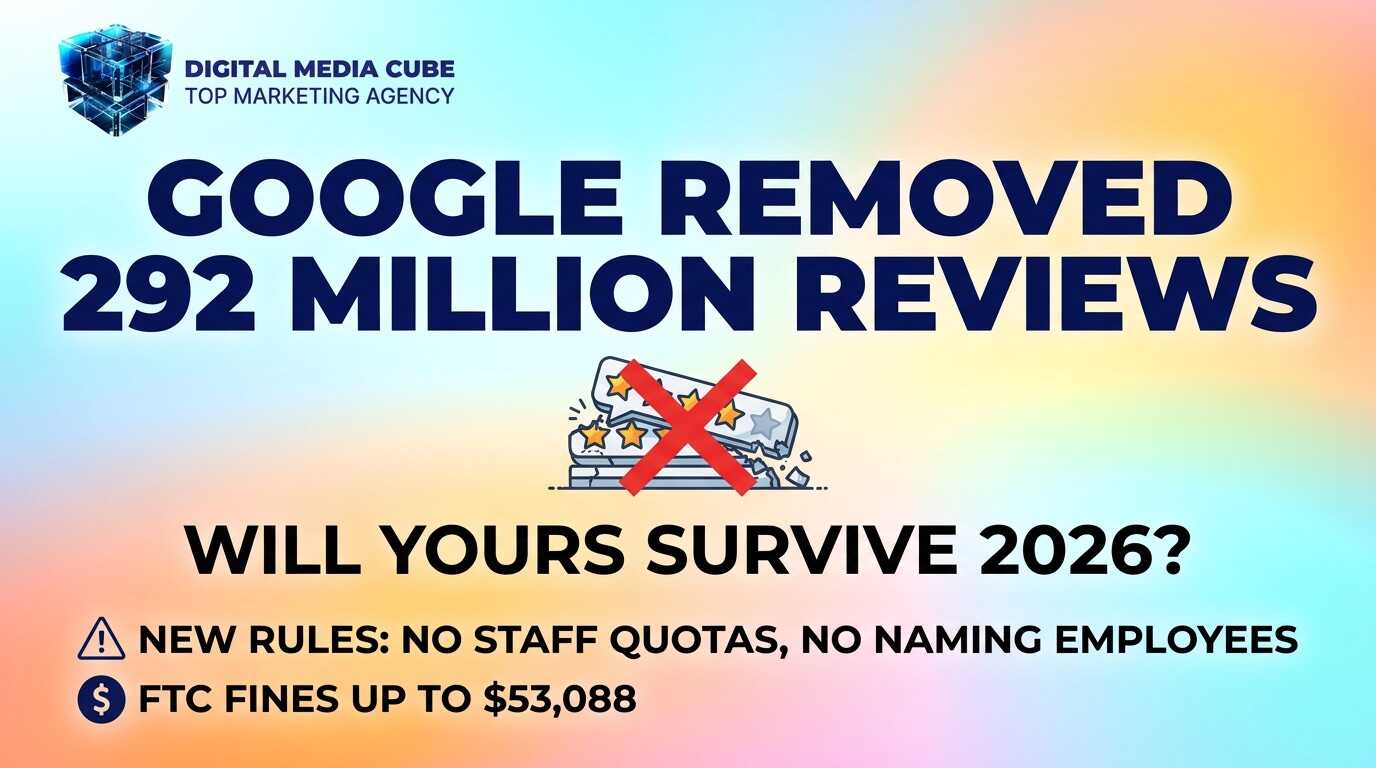
Google Removed 292 Million Reviews Last Year. Will Yours Survive 2026?
By Adrienne DeVita, Founder and CEO, Digital Media Cube
In April 2026, Google published its 2025 Trust and Safety Report for Maps and confirmed it blocked or removed more than 292 million policy violating reviews in a single year, alongside 13 million fake Business Profiles. One day later, Google quietly rewrote its rating manipulation policy to ban two practices that thousands of legitimate businesses use every week: setting review quotas for staff, and asking customers to mention an employee by name. If your practice does either one, you are out of compliance right now, and Google's enforcement is automated.
I want to be careful with the tone here, because there is a whole cottage industry of marketers who make a living scaring business owners. That is not what this is. Most of the practices I audit are not running fraud. They are running review programs somebody set up years ago, using software that came with the feature built in, following advice that was perfectly reasonable in 2019 and is a violation in 2026.
The rules moved. Here is where they moved to, what the exposure looks like, and how to build a review engine that survives the next round of changes too.
What Google Reported
On April 16, 2026, Google published its annual look at how it protects Maps, and the numbers are worth sitting with for a moment. Across 2025, Google's systems and analysts blocked or removed over 292 million policy violating reviews while publishing more than a billion legitimate ones. The company also blocked 79 million inaccurate or unverified edits to Business Profiles, removed more than 13 million fake Business Profiles, and placed posting restrictions on more than 783,000 accounts. (Google Maps blog)
Do the arithmetic on that and roughly one in five review attempts on Google Maps last year was classified as policy violating. That is the environment your practice is operating in.
The same announcement described three new protections. Google is using Gemini's reasoning to spot and block policy violating contributions before they go live, including scam patterns like demanding payment to remove fake one star reviews. It is rolling out proactive email alerts so verified owners can see important edits to their profile before those edits publish. And when it detects a sudden spike in spam reviews, it now takes a specific set of automatic actions: remove the fake content, pause new reviews on the profile, alert the owner, and display a public notification banner explaining to consumers why contributions are paused.
Read that last one again, because it is the part that should get your attention.
A public banner on your Business Profile, visible to every prospective patient searching your name, saying reviews are temporarily paused because of suspicious activity. That banner does not distinguish between a practice that bought reviews and a practice that got attacked by a competitor. The reputational cost lands the same way.
This is precisely why ongoing reputation management stopped being a nice to have. Knowing your normal review velocity, catching a spike or a sudden drop within days, and having a documented, compliant history to point to are what separate a bad week from a bad quarter when an automated system decides something looks wrong.
The Two Rules That Changed in April
The day after the Trust and Safety report, on April 17, 2026, Google edited the Maps user generated content policy itself. Two new clauses appeared under the Rating Manipulation section, and they are the ones that catch honest businesses.
Review quotas for staff are now an explicit violation. Telling your team they need to bring in a set number of reviews per month is a stated policy violation. Not a gray area. Not discouraged. A violation.
Asking customers to mention an employee by name is now an explicit violation. The hygienist card that says "if you were happy today, please leave a review and mention Jessica" is out.
I have seen both of these in nearly every practice I have audited in the last decade, and I want to be fair about why. They exist because they work operationally. A named review is more specific and more persuasive. A quota creates accountability. Every major practice management and CRM platform built these features because the market asked for them.
None of that matters to an automated enforcement system. The practice is the violation.
The Rule Most Practices Have Never Heard Of
Now for the one that worries me most, because it is the most common and the least understood.
Review gating is the practice of filtering customers before you ask for a public review. You send a satisfaction survey, and happy respondents get routed to your Google review link while unhappy ones get routed to a private feedback form that goes to the office manager. It feels responsible. It feels like good service recovery. Many practices do not even know their software is doing it, because it shipped as a default setting.
It has always violated Google's policy. What changed is that enforcement got smart enough to see the pattern rather than the individual review. A profile that consistently receives only positive reviews through one collection channel, while negative sentiment never appears anywhere, has a statistical signature. Google has also started targeting the software tools that facilitate gating rather than only the businesses using them.
And gating is not just a Google policy problem. It is a federal one.
The Layer Almost Nobody Is Talking About
The Federal Trade Commission's Rule on the Use of Consumer Reviews and Testimonials took effect on October 21, 2024. It prohibits fake reviews, buying or selling reviews, conditioning incentives on a reviewer expressing a particular sentiment, undisclosed reviews written by company insiders or their immediate relatives, and the suppression of legitimate negative reviews. (FTC)
For a while it looked like an education phase rule. That changed on December 22, 2025, when the FTC sent warning letters to ten companies over practices it believed may violate the rule, reminding them that violations can result in a federal lawsuit and civil penalties of up to $53,088 per violation. The FTC's own business blog noted, dryly, that penalties at that level can add up quickly. (FTC)
I am not an attorney and nothing here is legal advice. Talk to yours if you have any doubt about your current process. But I would rather you hear this from your marketing partner now than from a certified letter later.
Here is the practical translation for a practice owner. Offering a patient a discount, a gift card, a raffle entry, or a whitening kit specifically for a positive review is the exact conduct the rule targets. Routing unhappy patients away from your public profile is suppression. Having your office manager's spouse write a five star review without disclosure is an undisclosed insider review. These are not exotic scenarios. They are Tuesday in a lot of practices.
Why This Matters Twice as Much in an AI Driven Market
If the compliance argument does not move you, the visibility argument should.
Reviews were always a local ranking factor. What has changed is that reviews are now source material. When someone asks an AI assistant for the best implant dentist or the most trusted CDL school in their region, the system is reading review content, review sentiment, review recency, and how the business responds. Google's own guidance on generative AI features acknowledges that these systems surface what is said about businesses across the web, not just what businesses say about themselves.
That is the entire premise behind Generative Engine Optimization (GEO). Your reviews, your citations, and your off site record have to agree with each other and with your website, because an AI system checks several sources before it names a business. A clean, deep review profile is one of the strongest agreement signals you can own.
That means your review profile is being read twice. Once by the ranking system that decides whether you appear, and once by the language model that decides how to describe you. A thin, generic, five star only profile with no owner responses gives an AI nothing to work with. A profile with detailed reviews naming specific procedures, specific concerns, and specific outcomes gives it a rich picture to summarize.
None of that reading happens if you are not in the local pool to begin with, which is why local SEO services and review integrity have to be run as one program. Consistent business data, accurate categories, and a steady stream of real reviews are the same foundation viewed from two angles.
And here is the uncomfortable irony. The gated profile, the one engineered to look perfect, is the one that reads as least credible to both systems.
I wrote recently about how agentic search is pushing AI from recommending businesses to contacting them directly. Reviews sit right in the middle of that shortlist decision. If your profile gets frozen with a warning banner in the middle of that process, you are not in the comparison at all.
What a Compliant Review Engine Looks Like
The good news is that everything that works is still allowed. Here is what I build for clients:
- Ask every patient, not the happy ones. Universal requests are compliant and they produce a more believable rating profile. A 4.7 with 300 reviews outperforms a 5.0 with 40 in both consumer trust and AI summarization.
- Ask in a neutral voice. "We would appreciate your honest feedback about your visit" is compliant. "If you had a great experience, click here" is gating.
- Separate service recovery from review collection. You absolutely should have a process for catching unhappy patients and fixing problems. Run it as its own workflow for everyone, not as a filter that decides who sees your Google link.
- Kill the quotas and the leaderboards. Replace staff review targets with process targets. Measuring whether the request was made to every patient is compliant. Measuring how many reviews each person brought in is not.
- Stop asking for employee names. If a patient names their hygienist on their own, that is their review and it is fine. You just cannot request it.
- Never incentivize. No discounts, no gift cards, no raffle entries, no free whitening, in either direction. This is where FTC exposure is highest.
- Reply to every review, positive and negative. Owner responses are indexed, they are read by AI systems, and a calm professional reply to a critical review does more for your credibility than another five star.
- Watch your profile weekly. Turn on Google's proactive email alerts, and know your normal review velocity so you can spot an attack or a filter event early.
Most of that lives inside the profile itself, which is why serious Google Business Profile optimization now includes the review workflow rather than stopping at categories and photos. Accurate hours and services, current attributes, owner responses on every review, and a collection process that would survive an audit all feed the same listing that Google and every AI assistant read first.
None of that is clever. It is just correct, and it compounds. In over 20 years running this agency I have never bought a review for a client, never gated one, and never needed to. That is not a moral flex. It is the reason our client profiles have not been caught in any of the last three enforcement waves.
What This Looks Like in Your Niche
Dental Practices
You have the highest volume of routine patient contact of any niche I work in, which makes you both the biggest beneficiary of a clean review engine and the most exposed to quota culture. Front desk teams get review targets, hygienists get name drop cards, and the software does the gating in the background. Our approach to dental marketing starts by auditing that whole chain, because a practice with 400 legitimate reviews is nearly untouchable and a practice with 80 engineered ones is one policy sweep away from a bad quarter. Our longest dental relationship is 14 years, and that profile has never needed a shortcut.
Orthodontists
Your reviews carry unusual weight because the buyer is a parent making a four figure decision on behalf of a child, and they read carefully. Detailed reviews mentioning treatment length, payment plans, and how the office handled a broken bracket at 8pm are worth more than a wall of five star one liners. Patient orthodontic marketing is what turns those individual stories into a body of evidence. We have worked with our orthodontic client for almost 10 years and the depth of that review profile is a genuine competitive moat.
Plastic Surgeons
This is the niche where the FTC exposure is sharpest, because ticket sizes are high, testimonial marketing is standard practice, and the line between a patient testimonial and an incentivized endorsement gets blurry fast. If you feature patient stories on your site, make sure any material connection is disclosed. Our plastic surgery marketing work treats review and testimonial compliance as part of the build, not an afterthought.
Truck Driving Schools
Reviews are effectively your enrollment engine, because prospective students are comparing programs almost entirely on what former students say about job placement, instructor quality, and whether the advertised cost was the real cost. Graduation is a natural, honest review moment, and a school that asks every graduate builds an unassailable profile. Our truck driving school marketing approach is built around that rhythm.
If You Have Already Been Hit
If your review count dropped, your rating moved, or a banner appeared on your profile, do not panic and do not start generating replacement reviews. That is the single fastest way to turn a filter event into a restriction.
Document what happened, including screenshots and dates. Stop any collection process that could have triggered it, especially anything with a gate or an incentive. Use the Business Profile support channels to appeal, and be honest in the appeal, because the system has your history. Then rebuild slowly with compliant requests to real patients.
Rebuilding organic trust takes months, and you still need patients in the chair while it happens. A tightly managed Google Ads campaign keeps the phone ringing during the recovery window without putting a single additional review at risk.
I will be straight with you about the odds. Reinstatement of algorithmically removed reviews is difficult, and false positives do happen to legitimate businesses. That is genuinely unfair, and it is also the reality. The practices that recover fastest are the ones with a long, boring, compliant history the appeal can point to.
How We Handle This at Digital Media Cube
Review integrity is part of the SEO and Google Business Profile management we do for every client, not a separate line item. We audit the collection process end to end, including whatever your practice management software is doing by default, because that is where most violations are hiding. We monitor review velocity so an attack or a filter event gets caught in days rather than months. We write owner responses that are indexed, human, and useful to the next person reading them.
We also build the surrounding content marketing that gives AI systems and prospective patients context beyond the star rating, because a review profile alone is not a brand. Procedure pages, patient education, and honest answers to the questions people actually ask are what a summary gets built from.
Where all of that lands matters too. Our WordPress website design puts reviews, credentials, and booking in front of the visitor immediately, so the trust you earned on your Business Profile is not lost the moment someone clicks through to a slow or confusing site.
That is the whole approach at this brand marketing agency, and it has not changed since 2004. We do not take shortcuts, we take one client per niche per geographic area, and we build assets that survive policy changes instead of tactics that get outlawed by them.
Every enforcement wave is a redistribution. Visibility moves from the businesses that bought it to the businesses that earned it. If you have been doing this the hard way, this is your moment.
Frequently Asked Questions
Why did my Google reviews suddenly disappear?
Google's Gemini powered systems continuously scan for policy violations and remove reviews automatically. Common triggers include a sudden spike in review volume, reviews from accounts with low trust signals, patterns consistent with gating or incentives, and coordinated fake review campaigns. Legitimate reviews are sometimes caught as false positives. Google reported blocking or removing over 292 million policy violating reviews across 2025.
Is review gating illegal?
Review gating violates Google's policies and falls under the FTC's Rule on the Use of Consumer Reviews and Testimonials, which took effect in October 2024 and treats the suppression of legitimate negative reviews as prohibited conduct. Civil penalties can reach $53,088 per violation. This is not legal advice, and you should consult an attorney about your specific process.
Can I offer a discount in exchange for a Google review?
No. Conditioning any incentive on a review, particularly on a positive review, violates both Google's policy and the FTC rule. This includes discounts, gift cards, raffle entries, and free services.
Can I ask patients to mention their hygienist or assistant by name?
Not anymore. On April 17, 2026, Google added an explicit prohibition on asking reviewers to mention staff names. If a patient chooses to name someone on their own, that is fine.
Can I set review goals for my front desk team?
Google's updated policy explicitly prohibits merchants from requesting that staff solicit a set number of reviews. You can measure whether your team is consistently asking every patient, which is a process metric rather than an outcome quota.
Do reviews affect whether AI tools recommend my practice?
Yes. Review content, sentiment, recency, and owner responses are all read by AI systems when they generate recommendations. A detailed, credible review profile gives those systems more to work with than a small number of generic five star ratings.
Ready to Build a Review Engine That Lasts?
Most practices I talk to are one default software setting away from a problem they do not know they have. An audit takes very little of your time and tells you exactly where you stand.
We work with one client per niche per geographic area, so your market may or may not be open. Request a consultation or call us at (858) 215-2572. And if you qualify for our $5,000 monthly package, your first year custom website and hosting are included, a $10,780 value. See pricing for details.