Google Business Profile Data Is Coming to Google Analytics. Here’s Why That’s a Big Deal.
What's Actually Changing
Until now, Google Analytics could only "see" your Business Profile in a limited, clumsy way. You could tag the website link on your profile with UTM parameters and watch how many people clicked through to your site. That captured website visits, and nothing else. Every phone call, every direction request, every booking, and every message that happened directly on your listing was invisible to your analytics.
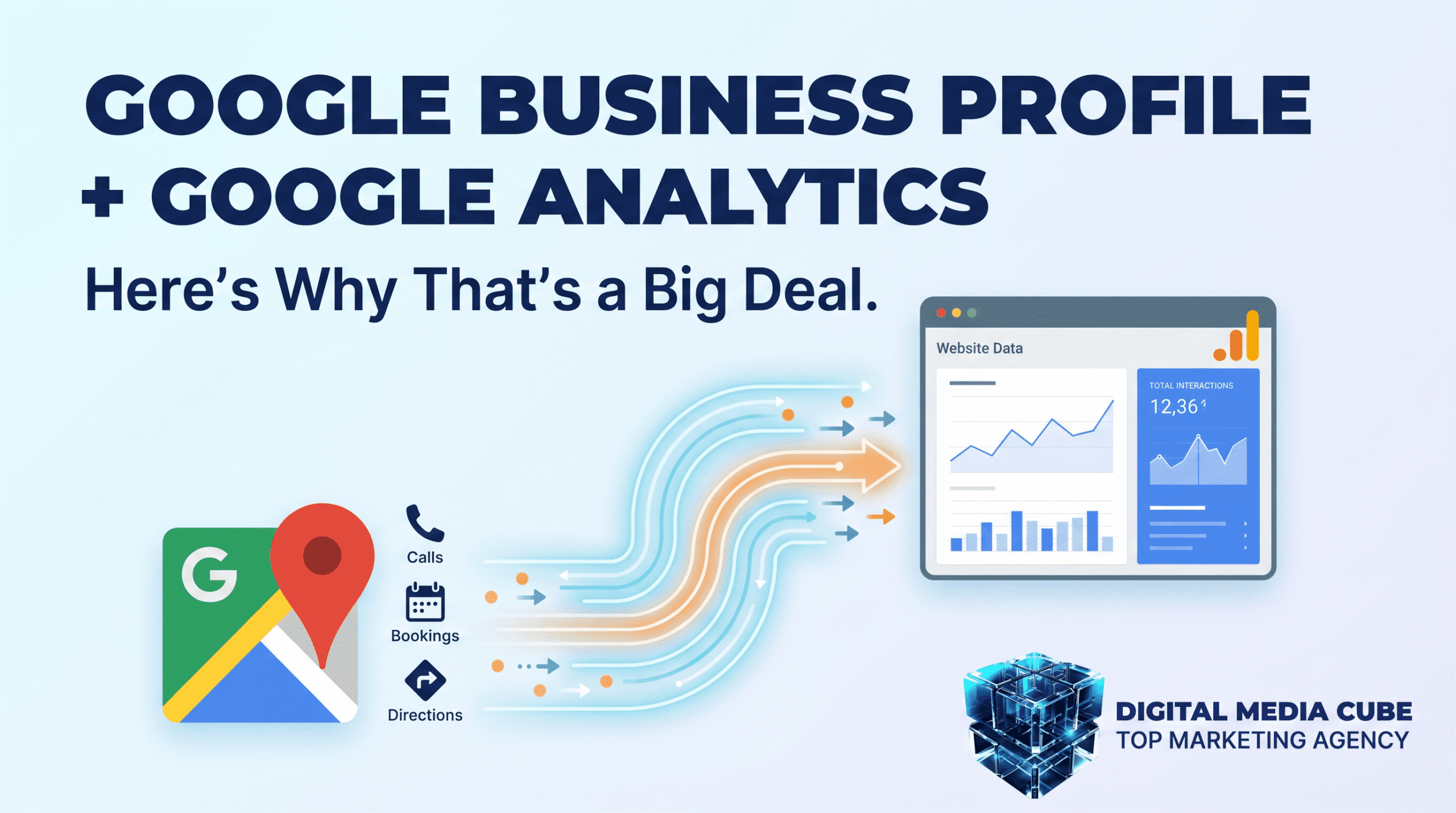
The new integration changes that. After you connect your Business Profile inside GA4, a dedicated reporting section appears that covers the full range of local interactions: total interactions, website clicks, calls, direction requests, messages, bookings, and menu views. For the first time, the actions people take directly in Google Search and Google Maps, the ones that show real intent and never involved a click to your website at all, become visible in the same dashboard as everything else. That's the part most owners don't yet appreciate, and it's the part that changes how you measure success.
Why Local SEO Reporting Has Always Been a Mess
Local SEO reporting has been awkward for as long as I've been doing this. Your website data sat in Google Analytics. Your Business Profile data sat in a separate dashboard. To understand the full picture, someone on your team, or your agency, had to pull from both, line them up, and try to reconcile numbers that were never designed to talk to each other.
That seam created a real blind spot. A practice could be generating hundreds of calls and direction requests straight from Google Maps and have almost no idea, because none of it showed up where they were looking. They'd judge their marketing by website traffic alone and miss the most valuable activity entirely. Closing that gap doesn't just make reporting tidier. It makes the truth easier to see.
Fixing fragmented reporting starts with having a strong foundation in place. Our SEO services are built around exactly this problem, ensuring your Business Profile, citations, and the signals on your own site all work together so that when the data
finally connects in GA4, what you're measuring is real growth, not noise. Businesses that have done that foundational work will get the most out of this integration from day one.
I've Seen This Measurement Gap for Twenty Years
I'm Adrienne DeVita, CEO of Digital Media Cube, and I've been helping businesses navigate online marketing since 2004. In all that time, one of the most persistent problems hasn't been visibility, it's been measurement. Business owners would tell me, "I think the marketing is working, but I can't really prove it." And they were often right to be unsure, because the data that would have proven it was scattered across platforms that didn't connect.
This is one of those quiet updates that does more than it appears to. It won't make headlines the way an AI announcement does. But for service businesses that live and die by local search, being able to see calls, bookings, and direction requests alongside website behavior is exactly the kind of clarity that lets you make smart decisions instead of guesses.
Why Calls and Direction Requests Matter More Than Clicks
Here's the insight most owners miss: a phone call and a direction request are not the same as a website click. They're far more valuable. When someone taps "Call" or "Get Directions" on your listing, they're usually much further down the decision path than someone casually clicking to your homepage. They're not browsing. They're choosing.
That's why being able to see those actions in GA4 is such a meaningful upgrade. You're no longer measuring curiosity. You're measuring intent. This is the same principle behind one of our truck driving school clients. As Brad Lawrence, Executive VP of SPCDL Truck Driving School, described it, within seven months the school grew by more than 57%, with stronger visibility across both traditional and search powered by AI, reaching the people who were serious about earning their CDL rather than those just hunting for random information. That distinction, reaching serious
buyers rather than idle browsers, is exactly what local intent signals reveal, and now you can finally track them.
Visibility in search powered by AI is increasingly part of the equation too. Generative Engine Optimization (GEO) prepares your content to appear in answers generated by AI, the kind of results Google is surfacing more and more alongside traditional listings. When your Business Profile data and your presence in AI search both point toward the same intent signals, the combined picture of how patients and students find you becomes far clearer.
Separating a Visibility Problem from a Conversion Problem
One of the most useful things this integration unlocks is the ability to tell two very different problems apart. Imagine a practice that generates four hundred direction requests a month but converts poorly once people reach the website or the front desk. That is a completely different situation from a practice with weak profile engagement across the board, and until now, those two problems looked almost identical in your reports.
Seeing Business Profile interactions next to conversions on your site lets you diagnose what's actually wrong. If the local engagement is strong but the bookings aren't following, the problem is conversion, not visibility, and you fix the website, the intake process, or the phone handling. If the engagement is weak to begin with, the problem is visibility, and you focus on the profile, the reviews, and the local authority. Same dashboard, two very different prescriptions.
Why This Is a Big Deal for Dentists and Orthodontists
Dental and orthodontic practices may benefit from this more than almost anyone, because so much of how a patient finds you happens locally. Someone searches for an Invisalign provider, a children's dentist, or an emergency appointment, sees your profile, and calls or asks for directions, often without ever visiting your website. Until now, that activity was nearly impossible to credit properly. Now it shows up where you can see it.
Orthodontic practices face the same challenge with an added layer of consideration. Patients comparing providers for Invisalign or braces are doing serious research before they call. Dedicated orthodontic marketing ensures your profile and your website both speak to that research phase, so that by the time a prospect taps “Call,” your practice is already the clear choice. When those calls show up in GA4, you’ll be able to tie them directly to the campaigns that earned them.
When you can watch calls and direction requests climb in step with your other marketing, you can finally connect the dots between the work and the patients. One of our dental clients, Lisa Harrison of Lakefront Family Dentistry here in Lake Elsinore, put it well when she said Adrienne's creativity, attention to detail, and knowledge of marketing have made a noticeable difference in their online presence and patient growth. This integration makes the line between the two far easier to see, and far easier to prove to yourself that it's worth the investment.
Practices ready to go further have a clear next step. Our dental marketing programs are built around the full patient acquisition funnel, from local search and profile optimization to the content, reviews, and paid campaigns that convert searchers into scheduled appointments. When GA4 starts showing you calls and direction requests from your profile, you'll want a strategy in place to keep driving those numbers up.
Why Plastic Surgeons Should Pay Attention
Plastic surgery is one of the industries where research and reputation matter most. Prospective patients spend weeks comparing providers, procedures, costs, and recovery before they ever reach out, and when they finally do, that first contact is incredibly valuable. Knowing where those consultation calls and booking requests are coming from is worth a great deal.
With Business Profile data in GA4, a surgical practice can start to see how its local presence drives the actions that signal real intent, not just raw website traffic. When the metric you're optimizing is consultations rather than clicks, you make very different and much better decisions about where to put your time and budget.
Surgeons who want to accelerate that process have a focused path forward. Our plastic surgery marketing programs are designed around the long consideration cycle that defines this industry, targeting prospective patients at every stage of their research, building trust through content and reviews, and converting that interest into consultation requests. Pairing that with GA4's new local data gives a surgical practice an unusually complete view of what's driving its pipeline.
Why Truck Driving Schools Benefit Too
Truck driving schools sit in an interesting spot, because the best of them serve students both locally and nationally. A school built around online theory students can complete from home, paired with practical instruction given one on one, is reaching prospects across a wide area while still needing them to physically show up for training. That makes the mix of website clicks, calls, and direction requests especially telling.
Direction requests signal someone who's seriously considering visiting your facility. Calls signal someone ready to ask real questions about enrollment, schedules, and endorsements. Being able to watch those actions in one dashboard helps a school understand which marketing is attracting committed future drivers rather than people just researching how to get a CDL. For schools competing in a space where most don't measure anything beyond a contact form, that clarity is a real edge.
Schools serious about growth can take that edge further. Our truck driving school marketing programs combine local search, targeted paid campaigns, and content built around the questions future CDL holders are actually asking, so the calls and direction requests showing up in GA4 come from candidates who are genuinely ready to enroll, not just curious. That's the difference between volume and quality in lead generation.
Local Visibility Is Worthless If the Phone Doesn't Ring
This is the part I never want owners to forget. Visibility is not the goal. Conversions are the goal. Being seen only matters if it turns into calls, bookings, visits, and
revenue, and the entire value of this integration is that it finally lets you watch that conversion happen instead of assuming it.
Think of a retailer we worked with, a furniture store with a physical showroom in Southern California. When we started, their Google Ads were quietly burning roughly three thousand dollars a month with nothing to show for it because the conversions weren't being tracked correctly, and a longstanding problem with their Google Local Business listing was fixed within forty-eight hours. The point of that story isn't the savings. It's that you cannot fix what you cannot see. When your local listing, your ads, and your website finally report into one place, the leaks become obvious, and so do the wins.
The same Google ecosystem that now surfaces your GBP data inside GA4 is also where Google Ads campaigns run, and for practices that use both, layering paid search data alongside your GBP conversion metrics creates a genuinely complete picture of how patients find and choose you. When you can see which search terms drive calls from ads alongside which GBP actions lead to directions and website visits, your budget decisions become much sharper.
The Limitations You Should Know About
The integration is rolling out in waves, which means it may not have reached your account yet. The connection toggle simply appears in your GA4 admin settings when it's available to you. There are also real constraints worth understanding:
- If you connect more than one Business Profile, GA4 currently aggregates everything into a single dataset with no way to segment by individual location, a genuine drawback for practices with multiple locations.
- The Business Profile data can't yet be used inside GA4's Explorations, comparisons, or custom filters, so analysis options are limited for now.
- The data reflects only the past six months at the moment, and updates sync with a short delay rather than instantly.
None of these are dealbreakers, but knowing them keeps your expectations accurate and your reporting honest, which is how we prefer to work.
What This Won't Fix
A clearer dashboard is a wonderful thing, but it doesn't create demand. Connecting your Business Profile to Google Analytics will show you what's happening; it won't, by itself, make more people call. The calls, bookings, and direction requests you're hoping to measure still must be earned through strong reviews, accurate and complete listings, genuinely helpful content, real authority, and a brand people recognize and trust.
In other words, this update rewards businesses that have already done the hard work of becoming visible and credible, because now they can finally prove the value of it. If the underlying local presence is weak, better measurement will simply show you that more clearly. That's still useful, but it's a reason to invest in authority, not a substitute for it.
Authority in local search is built largely on trust signals, and reviews are the most visible one. Proactive reputation management ensures that when someone sees your Business Profile for the first time, before they call or ask for directions, they see a practice or school with a strong, credible record. Measurement improvements only compound the value of a strong reputation; they don't replace the need for one.
How to Get Ready Right Now
You don't have to wait for the toggle to appear to prepare. The smartest thing you can do today is make sure the data will be worth measuring when the connection arrives. Start by claiming and fully completing your Google Business Profile: accurate name, address, phone, hours, services, categories, photos, and a working booking link if you offer one. Inconsistent or incomplete listings produce unreliable data, so cleaning that up now pays off later.
If your listing needs more than a quick cleanup, professional Google Business Profile optimization goes well beyond filling in fields — it covers category selection, service area accuracy, photo strategy, Q&A management, and the review cadence that signals relevance to Google. A fully optimized profile generates more interactions to measure, so the investment in optimization and the investment in analytics reinforce each other directly.
Next, make sure GA4 is properly installed on your website and that you've defined what counts as a conversion for your business: a booked appointment, a consultation request, a phone call, a form submission. When the Business Profile connection becomes available, you'll find it in the Product Links area of your GA4 admin settings. Connect it then, and because the data only reaches back about six months, the sooner you connect, the sooner you start building the history you'll want to compare against. If any of this feels like more than you want to manage, this is exactly the kind of setup we handle for clients every day.
One more detail worth checking before you connect: your website itself needs to be fast, mobile-friendly, and built to convert the traffic your Business Profile sends. Our WordPress website design service produces sites optimized for exactly this kind of local-to-web handoff — so when someone clicks through from your profile, they land on a page that gives them every reason to book. A great GA4 setup paired with a slow or confusing website is still a missed opportunity.
What to Measure Going Forward
Once the data flows, resist the urge to celebrate the biggest, shiniest number. Total interactions feel good, but they're not the scoreboard. The metrics that reflect a healthy practice or school are the ones that show real intent: calls, booking requests, direction requests, and the conversions those lead to on your website. Pair those with the numbers that matter most to your bottom line, such as qualified leads, consultations booked, revenue growth, and review growth, and you'll have a picture of your marketing that's honest and genuinely useful.
Data tells you what's happening; content is what earns the attention in the first place. Strategic content marketing services build the topical authority that puts your Business Profile in front of the right searchers, the ones whose calls and direction requests you'll now be able to measure in GA4. When content, local SEO, and analytics all point in the same direction, each investment makes the others more effective.
Frequently Asked Questions
What Your Google Business Profile Data Finally Lets You See
For two decades, the hardest part of local marketing wasn't doing the work. It was proving the work. Owners knew their marketing should be paying off, but the data needed to confirm it lived in too many places to make sense of. This update quietly fixes a meaningful piece of that, and the businesses that take advantage of it will stop guessing and start knowing.
At Digital Media Cube, that's what we've always cared about most: not vanity metrics, but real results you can see and trust. Calls answered, appointments booked, students enrolled, patients gained. The businesses that pair genuine local authority with honest, clear measurement will keep pulling ahead, because they'll know exactly what's working, exactly what isn't, and exactly where to invest next. The rest will still be staring at website traffic, wondering where their patients came from.
A Strong Brand Makes Your Google Business Profile Numbers Worth Celebrating
Underlying all of it is something that data alone cannot manufacture: a brand people recognize and choose on sight. Consistent work with a brand marketing agency ensures that every touchpoint, from your Business Profile to your website to your ads to your content, reinforces the same identity and promise. When your analytics finally connect those touchpoints in one dashboard, a strong brand is what makes the numbers worth celebrating.